WWII Historical Sites
Banzai Cliff
A clifftop memorial park at Marpi Point where civilians and soldiers died in the final days of the Battle of Saipan — dozens of monuments raised by Japanese families, prefectures and veterans' groups, on a headland that drops straight into deep blue water. A sacred pilgrimage site, and a separate place from nearby Suicide Cliff.
Banzai Cliff sits at Marpi Point, on the northern tip of Saipan, on ground the Chamorro call Banaderu. It is a low, grassy headland that ends abruptly — the limestone simply stops and drops into water deep enough to turn navy blue right at the base of the rock. The 7.5-acre site was individually listed on the U.S. National Register of Historic Places on August 27, 1976, and became a contributing site within the National Historic Landmark District “Landing Beaches; Aslito/Isley Field; & Marpi Point, Saipan Island” on February 4, 1985.
It is also, and mainly, a memorial. Dozens of monuments stand along the clifftop, most of them raised by Japanese families, prefectural associations, veterans’ groups, and religious organisations in the decades after the war. People still come here to pray.
History
In the final days of the Battle of Saipan, civilians and Imperial Japanese Army soldiers died at this cliff rather than be taken prisoner — many by jumping into the sea and rocks below. Japanese wartime propaganda had told them to expect brutal treatment at American hands. Some who went over the edge survived the fall and were recovered by U.S. Navy ships standing offshore. Okinawan civilians were among the dead.
The organised fighting on Saipan ended on 9 July 1944, when the island was declared secure. Japanese women, children, and other civilians who had retreated north ahead of the American advance reached Marpi Point in those last days, and it is there that many of them died.
The site takes its name from the banzai charge of 7 July 1944 — the largest of the Pacific war — which was made nearby, in the valley toward the Tanapag coast.
The monuments
The memorial park is not one monument but an accumulation of them, added over more than fifty years, and reading them is most of the reason to spend time here.
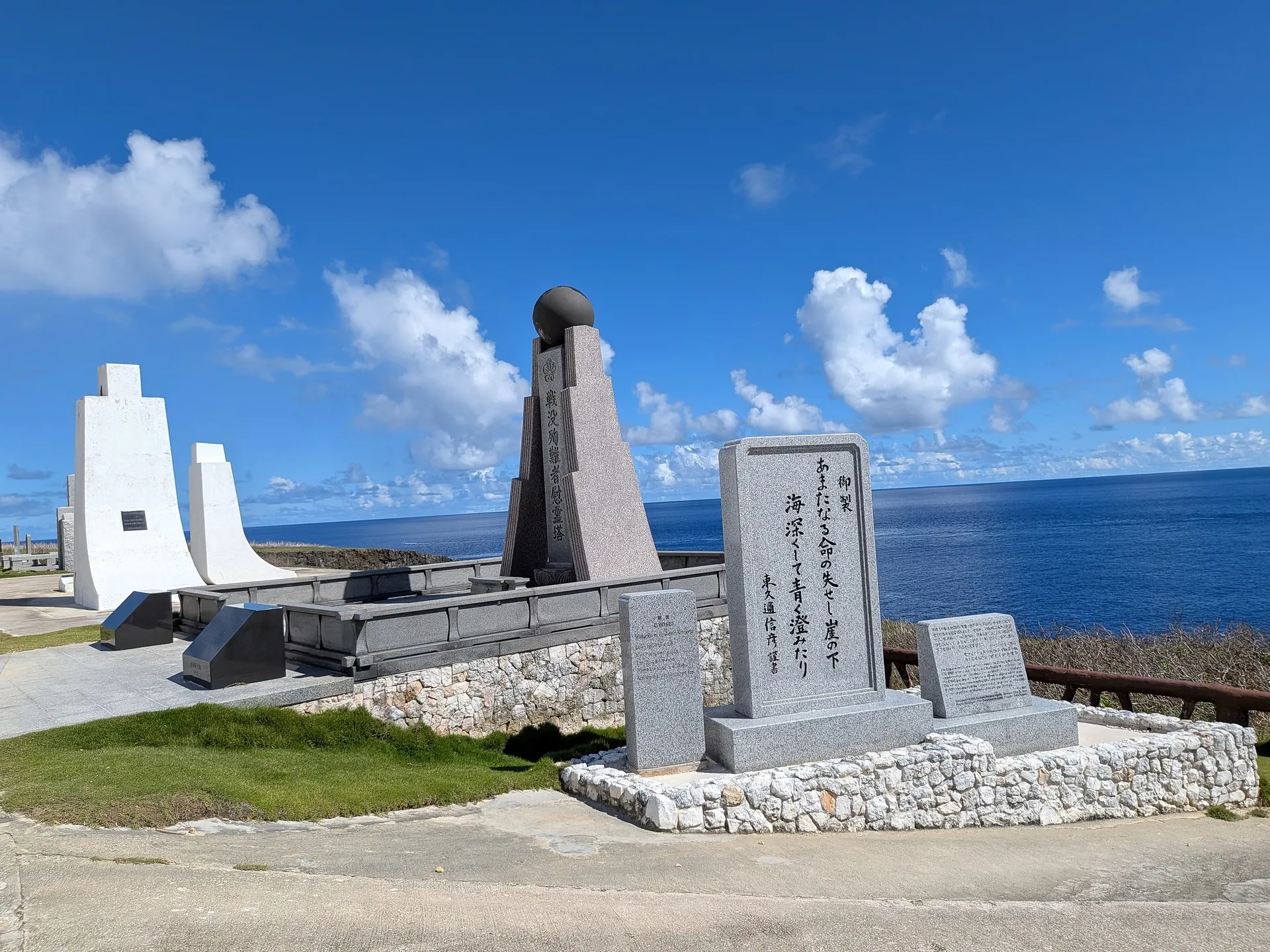
The dominant structure is a dark granite tower, tapering upward to a stone sphere and bearing a chrysanthemum crest, dedicated to the war dead. A separate plaque set in front of it was placed in 2008 by donors from Osaka, expressing the hope that such conflict disappears from the world.
Beside it stands a pale granite stone carrying an imperial poem (gyosei) — a short waka about the many lives lost beneath the cliff, and the deep, clear blue of the sea below. Elsewhere on the site, a separate polished stone carries an English translation of a different imperial poem, erected in February 1992.
Nearest the cliff edge stand two curved white pylons — the Tower of the Pacific (太平洋之塔), dedicated in March 1970. Its plaque, in Japanese and English, dedicates the monument to the spirits of the war dead and calls for “the creation of the Pacific global era.” Weathered and streaked with rust now, it is the most architecturally striking thing on the headland.
Further inland, a white Kannon statue — the Buddhist figure of compassion — stands in a small garden, with the limestone mass of Suicide Cliff rising directly behind it. That single view is the clearest illustration of something visitors routinely get wrong: Banzai Cliff and Suicide Cliff are two separate places. You can see one from the other, and they commemorate deaths in the same days of the same battle, but they are not the same site.
Getting there
From Garapan it’s a 20–30 minute drive north, and the route is paved the whole way; the final approach narrows as it crosses the Marpi flats. There’s a free paved parking area at the top with a restroom block and a covered pavilion beside it.
From the parking area a paved, mostly level path runs along the clifftop past the monuments to the overlook, with timber-style railings on the seaward side and benches along the way. It’s an easy walk, and the far end of it — where the path opens onto the cliff face and the undercut limestone below — is the part most visitors skip.
Banzai Cliff is a standard stop on Northern Saipan half-day WWII tours, almost always paired with Suicide Cliff and the Last Command Post. Doing all three in one loop is genuinely the right way to visit: separately they are viewpoints, together they are the north end of a battle.
Visitor Etiquette
- A sacred pilgrimage site — Japanese families still come here to pray for relatives who died at Marpi. Treat cenotaphs, statues, and offerings with care.
- Do not climb on memorials, remove offerings, or take stones or sand.
- Keep voices low; no drones, no loud music, no picnicking at the cliff edge.
- Use "civilian and military deaths at the close of the Battle of Saipan" rather than colloquial "suicide spot" framing.