WWII Historical Sites
Suicide Cliff
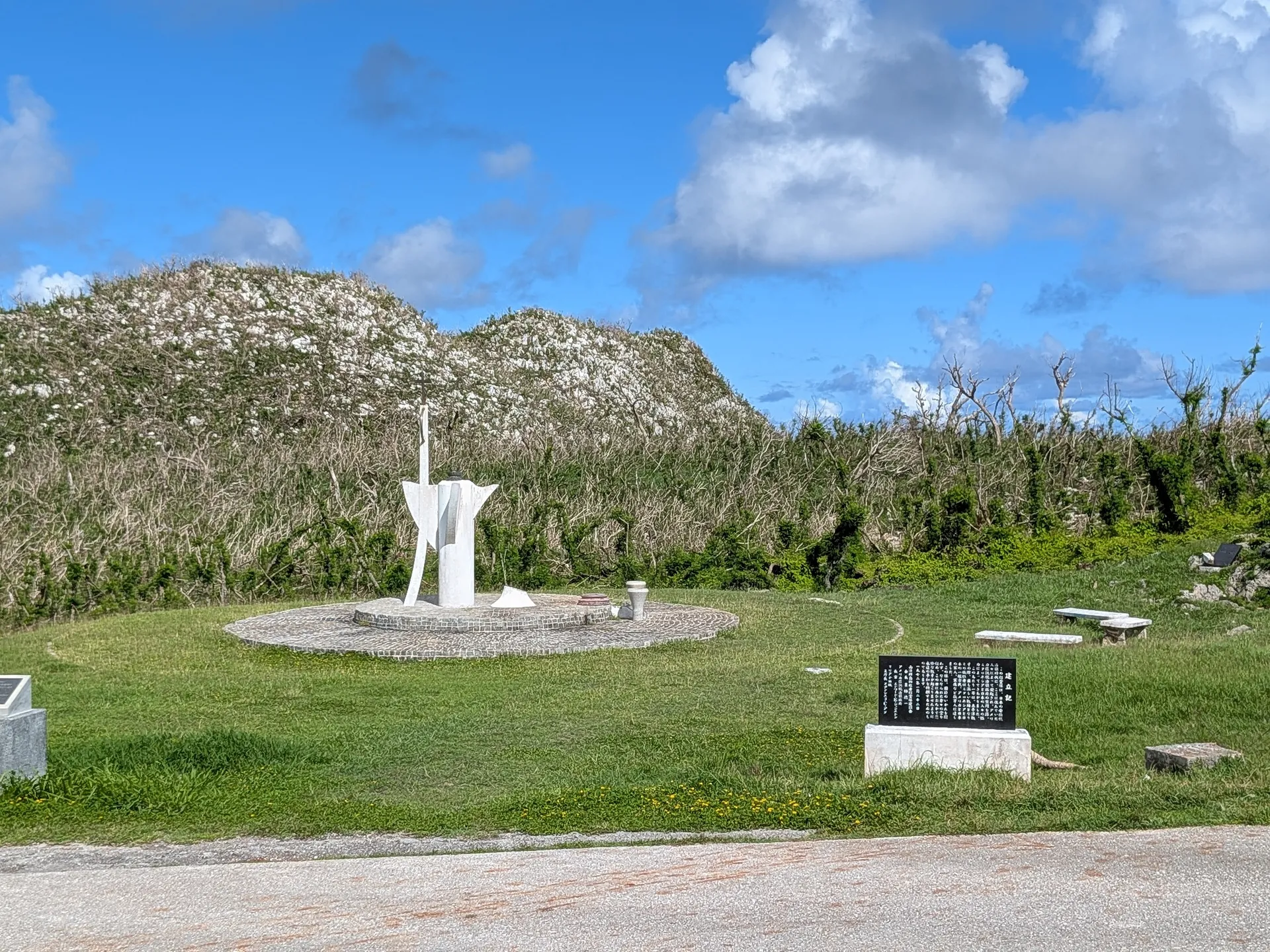
A clifftop peace memorial park on Mt. Marpi — Laderan Banadero in Chamorro — where a joint U.S.-Japan-Micronesia memorial has stood since 1972. One of the final and most solemn sites of the Battle of Saipan, and a separate place from nearby Banzai Cliff, though you can see one from the other.
Suicide Cliff sits on Mt. Marpi — Laderan Banadero in Chamorro — at the northern tip of Saipan, just south of Banzai Cliff, rising over 800 feet above the Marpi Point coastal plain. The 9-acre site was individually listed on the U.S. National Register of Historic Places on September 30, 1976, and became a contributing site in the same National Historic Landmark District as Banzai Cliff on February 4, 1985.
History
Throughout late June and early July 1944, hundreds of Japanese civilians and Imperial Japanese Army soldiers took their own lives by jumping from the cliff. The exact total is unknown — one U.S. eyewitness described seeing hundreds of bodies below, while other accounts cite thousands. Families, women, and children jumped together; some were encouraged or coerced by Japanese military personnel. Wikipedia’s account of the Battle of Saipan cites about 1,000 civilian deaths across the broader Marpi Point area after organized resistance ended on 7–9 July 1944.
The memorial
The clifftop peace statue is dated by its own black granite founding stone: erected January 22, 1972, by the South Seas Islands War Dead Memorial Statue Construction Association, with the consent of the U.S. Trust Territory government. The inscription is specific about who built it and why — it names Kuribayashi Tokuichi as the association’s chairman, Edward E. Johnston as U.S. High Commissioner of the Trust Territory, and Francisco C. Ada as the Mariana Islands District Administrator. (Ada later became the CNMI’s first Lieutenant Governor, and Saipan’s international airport now carries his name.) The stone states the memorial honors the dead of the battle regardless of nationality — Micronesian, American, and Japanese military and civilians alike — and was built through cooperation between Micronesian, Japanese, and American people during the U.S. administration era.
A separate marker near the parking area explains something easy to walk past without noticing: damaged cenotaphs from elsewhere in the memorial park are deliberately buried at that spot, placed there by the Japan War-Bereaved Families Association rather than simply discarded when they were replaced or repaired.
Getting there
From Garapan, Suicide Cliff is a 20–30 minute drive on a paved road, with a free paved parking loop right at the memorial complex. It’s a standard stop on Northern Saipan WWII tours, and pairs naturally with Banzai Cliff and the Last Command Post — all three sit within a few minutes of each other in Marpi.
The height is the thing that makes Suicide Cliff worth visiting on its own terms rather than as a Banzai Cliff footnote: from the clifftop railing you look straight down onto Banzai Cliff’s entire memorial park — its loop road and monument cluster laid out clearly on the coastal plain below — with the open Pacific beyond and the coastline running north toward Bird Island Lookout. It’s the one spot in Marpi where the geography of these separate sites actually resolves into a single view.
Visitor Etiquette
- A sacred site memorializing the deaths of Japanese, Okinawan, Micronesian, American and other civilians and combatants at the close of the Battle of Saipan.
- The cliff is unfenced in places and the drop is sheer — keep a safe distance, especially with children.
- No loud behavior, no music, no drone flying directly over the cliff edge; do not remove stones or offerings.