Nature & Culture
Mount Tapochau
Saipan's highest point — a narrow summit ridge with a 1987 statue of Christ at one end, a working communications tower at the other, and a 360-degree view where both coasts are visible without turning your head much. Also the site of the island's biggest annual hike, every Good Friday.
Mount Tapochau is a limestone-capped mountain rising 474 m (1,555 ft) above central Saipan — the highest point on the island — sitting north of San Vicente village and northwest of Magicienne Bay. The summit ridge is narrow enough to feel like a knife-edge in places, with a white statue of Christ at one end, a working communications tower at the other, and open ocean visible on both sides of the island at once.
History
Mount Tapochau was a key Japanese defensive and observation position during the Battle of Saipan in June and July 1944, overrun by U.S. Marines in the closing days of the battle. The U.S. military continued to use the summit for observation afterward — an AN/CPS-1 MEW radar antenna was installed here in January 1945, part of the air-defense network covering the newly captured island. The Last Japanese Command Post — a separate site near the Grotto in Marpi — is associated with this same battle narrative, but it lies below Tapochau on the north coast, not on the mountain itself.
After WWII, the summit continued to serve as a communications and observation site during the U.S. Naval administration era — the tower standing there today is a direct descendant of that use, not a new addition. The mountain passed through the U.S. Trust Territory of the Pacific Islands starting in 1947, becoming part of the CNMI in 1986.
The statue, and the Good Friday hike
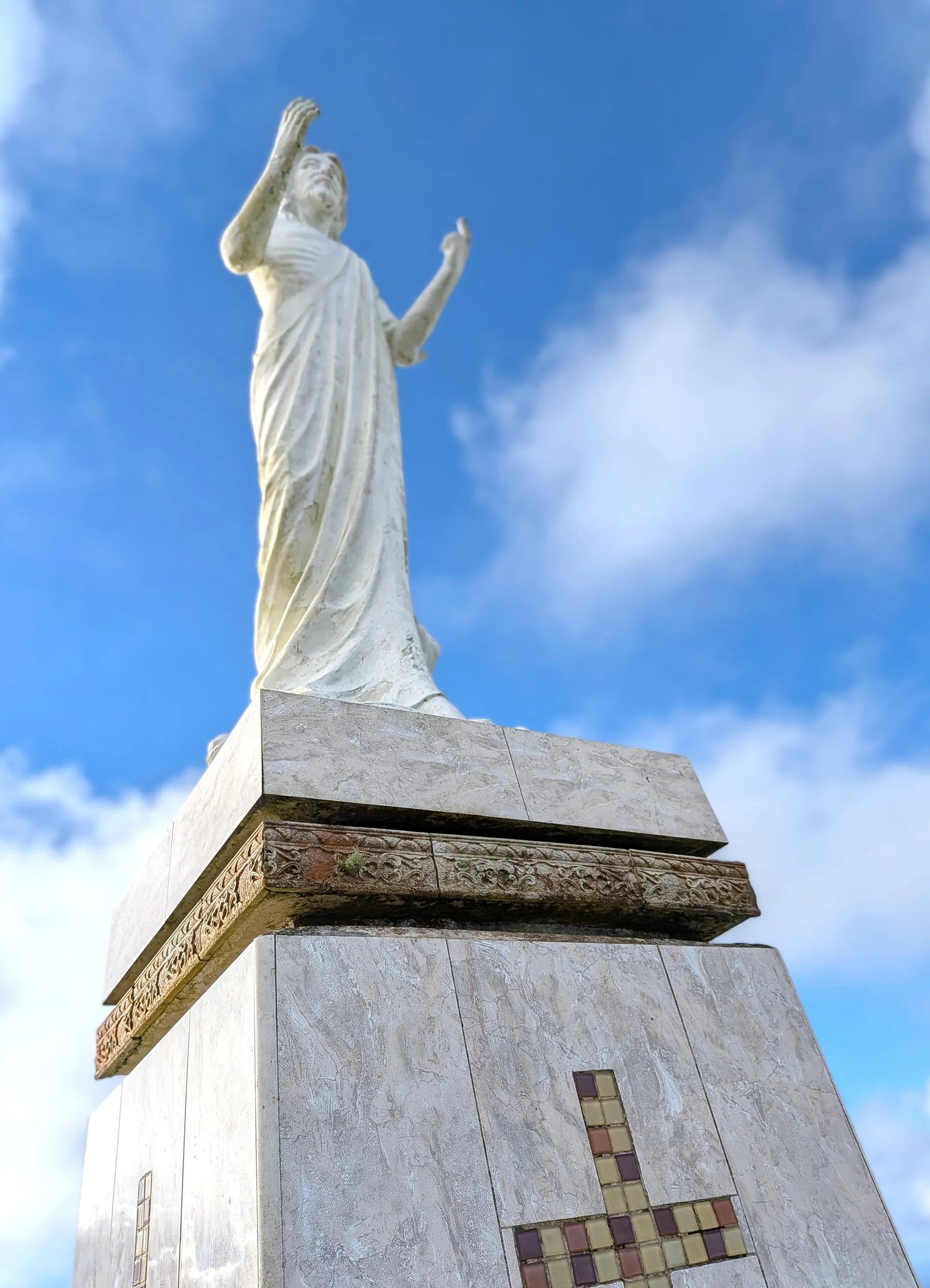
The summit statue — a robed figure of Christ facing the western shore, arms raised — carries its own dedication plaque at the base: “Christ Has Died, Christ Is Risen, Christ Will Come Again.” It was donated by Mr. & Mrs. Juan S.N. Cabrera and family, constructed by the Youth of the Commonwealth under architect Herman B. Cabrera and contractor N.C. Godino, and dedicated at Easter 1987.
That dedication points at something easy to miss if you only think of this as a viewpoint: Mount Tapochau is a living pilgrimage site. Every Good Friday, an 18-foot wooden cross — weighing over 100 lbs, blessed beforehand at Mount Carmel Cathedral in Chalan Kanoa — is carried on foot to the summit by a procession that can start as early as 2am, past Stations of the Cross placed along the path. It’s a tradition more than thirty years running and one of the largest annual public gatherings on the island. If you want to see it, go that day; if you want the view to yourself, pick any other.
Getting there
From Garapan, the drive to the upper parking area takes roughly 20–30 minutes via a paved road that turns rough and rocky near the top. The final stretch to the statue is paved steps with a handrail rather than loose rock underfoot the whole way, though the road leading up to it is a different matter — an SUV or 4WD has a real edge over a standard sedan, especially after rain.
At the time of these photos there was active construction or site work visible near the summit — equipment, staged materials, barrier tape around parts of the parking area. Whether that’s finished or ongoing isn’t confirmed; budget for the possibility of some disruption.
What to expect
The reward is a 360-degree panoramic view of all of Saipan, with sightlines to neighboring islands — Tinian’s silhouette is visible on a clear day, and Aguijan further still. It’s a popular sunrise and sunset photography spot, and the summit carries five official National Park Service wayside panels — Preparing for Invasion, Swing Like a Gate, Death in the Valley, Taking Mount Tapochao, and Jungle Fighting Goes On — sited where some of the most intense fighting of the Battle of Saipan actually happened, not just a general WWII marker. The waysides page is tagged under American Memorial Park, the U.S. National Park Service-affiliated site in Garapan — the same NPS connection Banzai Cliff carries.
There are no facilities at the top, and no guardrails at the cliff edges on several sides of the summit, so keep a safe distance, especially with children.
Visitor Etiquette
- Respect the summit statue of Jesus Christ; modest dress is customary, and it remains an active site of prayer and pilgrimage — not just a viewpoint.
- Keep back from the unfenced cliff edges on multiple sides of the summit — the ridge is narrow and drops steeply on both sides.