Nature & Culture
Bird Island Lookout
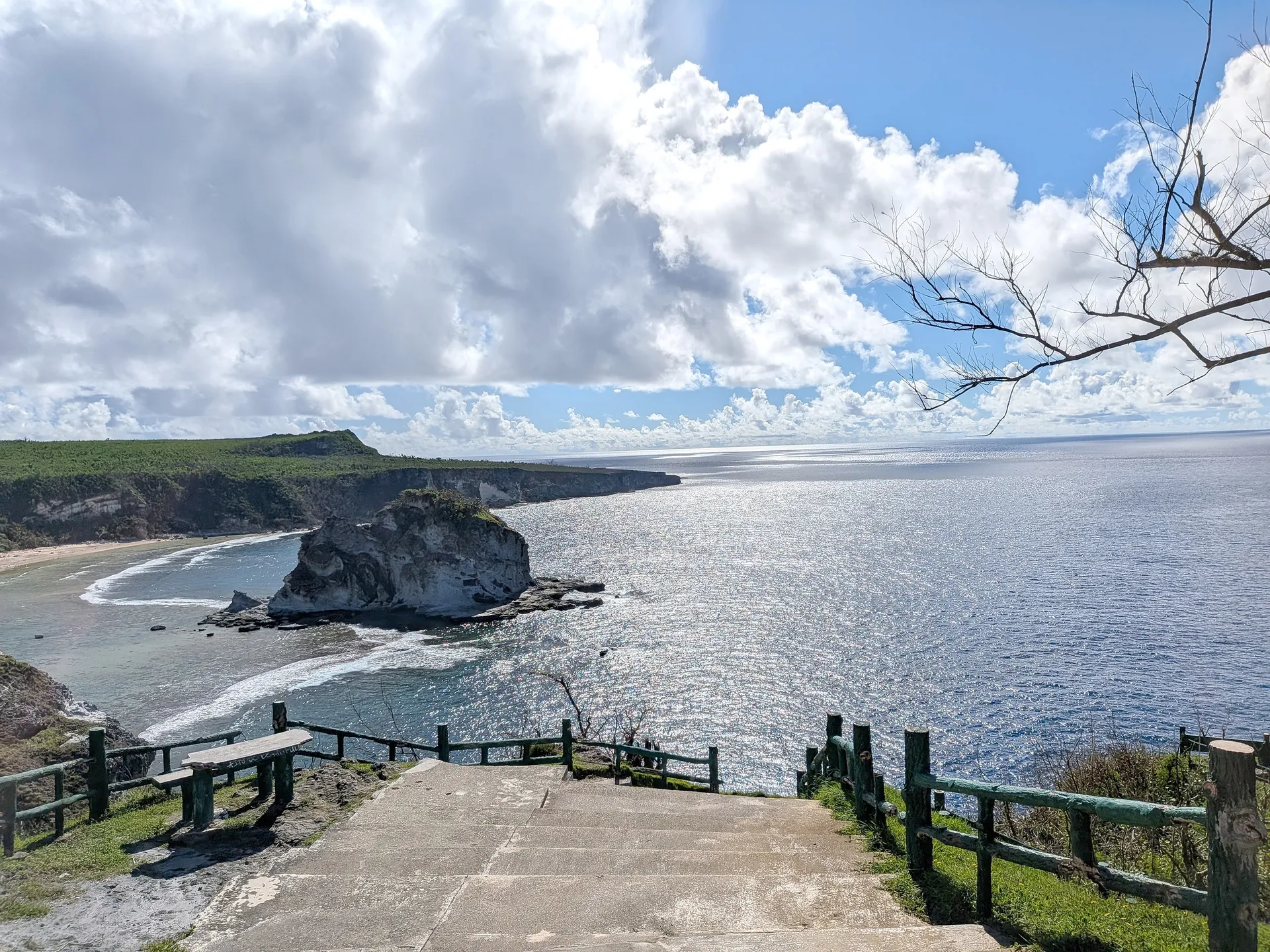
A terraced cliffside overlook on Saipan's northeastern coast, above a limestone islet sitting in a turquoise bay — the most photographed viewpoint on the island, and part of a no-take marine sanctuary shared with The Grotto.
Bird Island Lookout sits on Saipan’s northeastern coast, in the San Roque/Marpi area just east of The Grotto. From the clifftop you look down over a small limestone islet standing on the reef in a shallow, sheltered bay — Isleta Maigo’ Fahang, Bird Island. It’s the most photographed view on Saipan, and unlike a lot of things that carry that description, it earns it.
What it is
The islet is a chunk of undercut, wave-carved limestone, green-capped and ringed by breaking surf, sitting maybe a couple of hundred metres offshore inside the reef line. The birds it’s named for nest on it, which is part of why nobody is allowed to land there.
The lookout itself is a terraced set of concrete platforms stepping down the cliff, linked by stairs and lined with painted timber railings, with picnic tables and bench seating at the top. It’s a viewpoint rather than a park — there’s nothing here to do but look, which is fine, because the looking is the point.
Conservation
Both the islet and the water around it are protected. The Bird Island Marine Sanctuary was created by Public Law 12-46 in April 2001, alongside the Forbidden Island Marine Sanctuary, as a full no-take area — no fishing, no collecting, nothing removed. Its boundaries run from Lichan Point south to take in The Grotto, Bird Island, Bird Island Bay and the lookout itself, extending 1,000 feet seaward from the low tide line and 500 feet up the cliff face.
On the land side, the Bird Island Wildlife Conservation Area covers 118 hectares and is managed by CNMI DLNR. Together the two areas protect roughly 268 hectares of land and ocean. The reef inside the sanctuary is among the healthiest in the CNMI — a fairly direct argument for what leaving a place alone does for it.
Bird Island’s soft limestone still carries shell and mortar scarring from U.S. bombardment during the 1944 Battle of Saipan.
Getting there
From Garapan it’s about 25–30 minutes north, up Route 30 and then the signed turn past the Grotto road. The approach is paved and there’s a free parking area at the top. A short flight of concrete steps leads from the parking area down to the upper viewing platform, and more steps continue down to the lower terraces.
A separate route, the Bird Island Trail, starts from Bird Island Lane rather than the lookout’s own parking area and descends to the beach beside the islet itself — a genuine hike on rough, unimproved ground rather than a short paved walk. It’s worth doing if you want to be at sea level next to Bird Island rather than looking down at it from the cliff, but go in with the right expectations: this is a real trail, not a stroll, and it’s inside a protected marine sanctuary — stay on the path and leave the reef and shoreline undisturbed.
The locals’ layer
Come in the afternoon. This is the single thing worth knowing before you drive up. The lookout faces roughly northeast over open ocean, so in the morning the sun is directly in front of you and the entire bay turns to white glare — the water loses its colour completely. The same view later in the day, with the sun behind you, is the shot people come for.
Walk down. Most visitors take the view from the top platform and go. The lower terraces are thirty seconds of stairs away and give you a better angle: the islet set against the curve of the beach and the reef instead of flat against open water.
Expect storm damage in the frame. The bare branches around the upper platform aren’t seasonal — they’re what’s left after consecutive Typhoon Sinlaku and Typhoon Bavi. They’re hard to avoid from the top; the lower terraces give you a cleaner foreground.
Visitor Etiquette
- Stay behind the railings. Beyond them the ground gives way quickly and the drop is sheer.
- Do not attempt to reach Bird Island itself — it's a protected sanctuary and the channel between is dangerous.
- No fishing or collecting anywhere in the sanctuary — it's a full no-take area, and that's what keeps the reef here as healthy as it is.
- Wear shoes with grip for the steps down to the lower terraces.
- If you take the trail down to the beach beside the islet, stay on the path and pack out everything you bring — this is heavily protected marine sanctuary, not an ordinary hiking trail, and it's easy to do real damage to the reef and shoreline without meaning to.