Beaches
Unai Fanhang
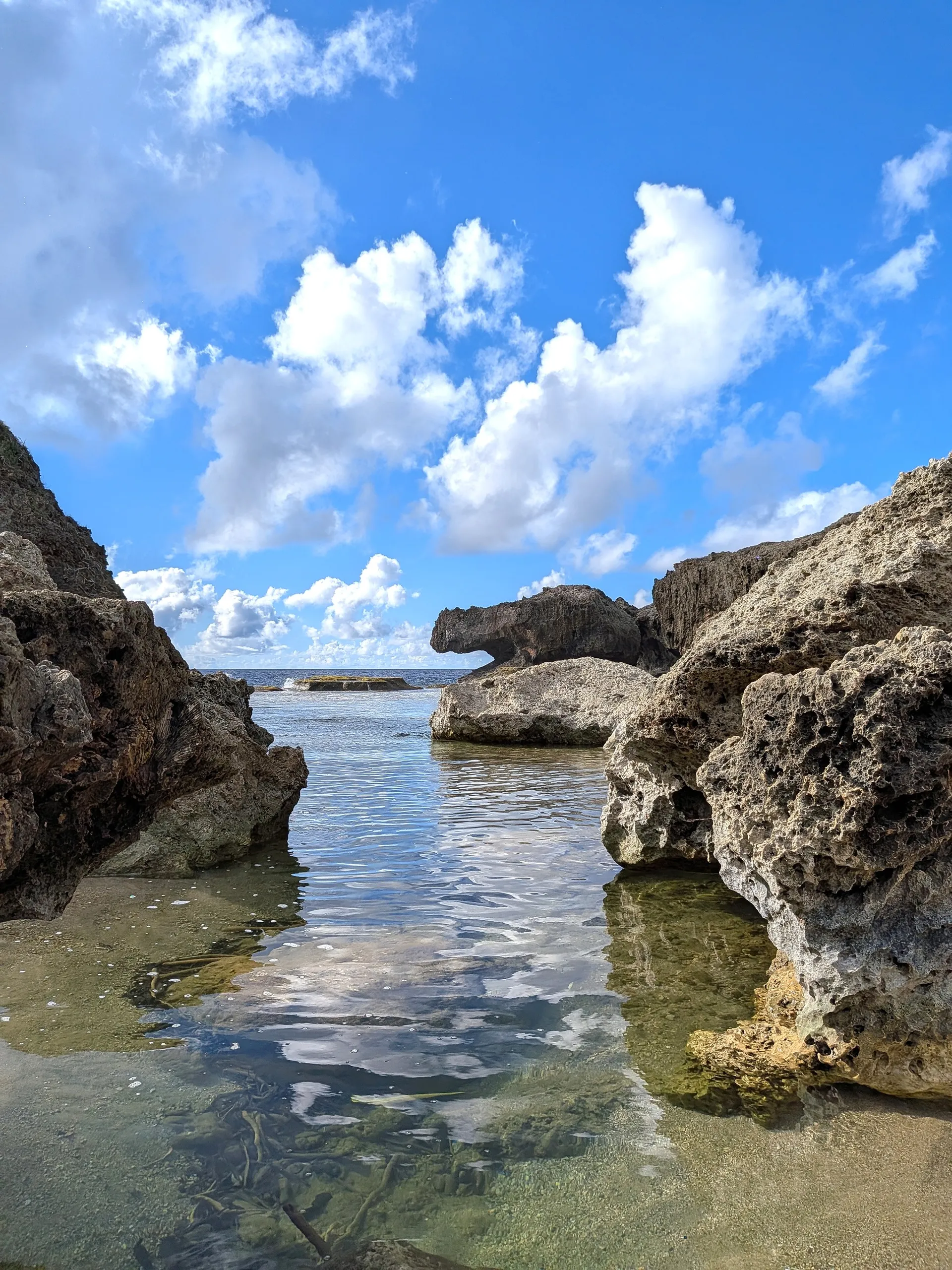
A rugged limestone shore on Saipan's northeast coast — listed on Google Maps as San Juan Beach — built around an alligator-shaped rock formation with sea caves you can walk into at low tide. Spectacular, genuinely dangerous when the tide is up, and far easier to reach since the new road went in.
Unai Fanhang — Fanhang Beach, and confusingly filed on Google Maps as San Juan Beach — is on Saipan’s northeast coast, and calling it a beach undersells what’s actually there. There’s sand, but the site is really a stretch of raw, undercut limestone: rock shelves, tidal channels, sea caves, and a headland formation that looks unmistakably like an alligator with its jaw open, staring out to sea.
It rewards timing more than any other coastal spot on this side of the island. Come at low tide and it’s an hour of proper exploring. Come at high tide and most of it is underwater and dangerous.
The alligator, and the caves
The formation everyone comes for sits on the seaward edge of the inlet. From the shore it reads as a long snout and an open mouth, and it holds that shape from most angles along the channel — you won’t need anyone to point it out.
At the base of the surrounding rock, low tide exposes a set of small sea caves and undercuts you can walk into. They’re shallow, more alcoves than caverns, and that’s precisely the point: they’re only there for a few hours either side of low water. When the tide comes back in, they fill.
There’s also a spot along the rocks where incoming surf funnels into a gap and fires spray upward. Get the timing right and it’s the best photograph on the site. Getting the timing right means waiting for a set from a safe distance, not standing close and hoping.
A word about safety
The sign at the entrance isn’t decorative. It’s in English, Japanese, Korean and Chinese, and it carries a no-swimming pictogram alongside warnings for strong undercurrents, high surf, and falling rocks. Its own wording: “No lifeguard on duty… You could be swept away from shore and could drown… Enter at your own risk.”
That reads like standard liability boilerplate until you stand on the rock shelf and watch a set come through. Treat Fanhang as a place to explore on foot at low tide, not a place to swim, and it’s fine. Treat it casually at high tide and it isn’t.
Storm damage, and recovery
The palms behind the shore are bare trunks. Consecutive Typhoon Sinlaku and Typhoon Bavi went through this coast hard, and Fanhang took it without any of the sheltering that the lagoon side gets — the row of stripped, headless coconut trees standing over the sand is the most direct picture of that damage anywhere on the island’s public shoreline.
It’s a genuinely bleak thing to look at, and worth being honest about rather than cropping out. It’s also worth saying that the vegetation at ground level is already coming back green between the rocks, and Saipan’s shorelines have recovered from worse. Give it a few seasons.
Getting there
Fanhang is roughly 25–35 minutes from Garapan, and the drive is the good news. Windward Road, the new coast road serving this stretch, is paved and properly built, with roadside parking above the shore and a concrete stairway with steel handrails running down to the sand — a real improvement on what used to be a rough approach.
The bigger win is what Windward Road unlocks past Fanhang: reaching Kalabera Cave, the ancient CHamoru burial cave further along this coast, is now far easier than it used to be. Between the two, roughly midway, is Unai Nanasu (Nanasu Beach) — another stop worth building into the same trip; photos and a full write-up are coming soon.
The three together have become the standard loop for this side of the island: Unai Fanhang → Unai Nanasu → Kalabera Cave, all strung along Windward Road, all reachable in one run now that the road’s in. There’s a picnic area at Fanhang set back from the water if you want to break the loop up rather than push straight through.
It also pairs naturally with the other northeast-coast sites — Bird Island Lookout is the obvious companion stop, and Banzai Cliff is a short run further north into Marpi.
Visitor Etiquette
- Check the tide before you go down. This is a low-tide place — at high tide the caves and channels fill and the same ground becomes genuinely dangerous.
- Don't turn your back on the water. Surf here arrives in sets, and the rock shelf is slick where it's wet.
- Take your rubbish out with you — there are no bins, and nobody is servicing this site.
- Leave the rocks and shells where they are.