Nature & Culture
Kalabera Cave
An ancient CHamoru burial cave in Marpi, carved with dozens of prehistoric rock engravings and later used as shelter and a field hospital during the Battle of Saipan — now a developed heritage site with a boardwalk, replica latte hut, and interpretive panels.
Kalabera Cave sits inland at the foot of a forested limestone ridge in northern Saipan. The name is the CHamoru word for skull, taken from the Spanish calavera — and it is not decorative. This was an ancient CHamoru burial cave, and it is still treated as a place of respect.
It’s also the most substantial cultural site on this side of the island, and the one most people drive past without stopping.
Why it matters
The cave holds more than forty-five prehistoric rock engravings, most between five and ten inches across. The majority depict headless human figures — a motif that connects directly to how the ancestral CHamoru treated their dead. Remains were buried, and after a period the skull was recovered, cleaned, and kept in the family home, so that the person stayed present among the living rather than departing entirely. The cave’s name, the engravings, and that practice are all describing the same thing.
Crucially, the art isn’t hidden away in the dark: it sits on the wall just inside the entrance portal, on the left-hand side. You are standing a few metres from it at the viewing platform. Almost nobody knows to look — the local press has run pieces on exactly that — because there’s no marker at the platform pointing it out.
That’s the layer worth carrying up the boardwalk with you. Without it, this is a hole in a cliff; with it, it’s one of the clearest surviving statements of pre-contact CHamoru belief anywhere in the Marianas.
The entrance chamber itself is substantial — the entry room stands close to 60 feet high.
History
The colonial accounts — treat with caution. Two later stories attach to Kalabera, and both are worth knowing about and worth holding loosely.
The first is that the cave was used as a prison for CHamoru people during the Spanish colonial period. It’s repeated in several places, but it isn’t well evidenced, and at least one cave survey dismisses it as implausible on practical grounds — the chamber simply isn’t suited to holding anyone.
The second is that the site was a Japanese officers’ “recreation club” during the pre-war occupation. That one is explicitly reported as reputation rather than record, with no corroborating detail about when or in what form.
Neither is stated here as fact. They’re part of how the place is talked about locally, which is a different thing from what’s documented.
The war years. Kalabera’s second history is the one it was better known for through most of the twentieth century. During the Battle of Saipan in 1944, civilians and combatants sheltered in the cave, and it was used as a field hospital. Ordnance, personal belongings and human remains were still being recovered from within thirty to fifty feet of the entrance long after the war ended.
So the site carries two separate sets of dead, centuries apart, in the same chamber. Both are reasons to keep your voice down.
What’s actually there
The developed site sits on a lawn below the ridge. Nearest the parking area is a replica ancient CHamoru latte hut — a thatched timber house raised on latte pillars, the stone columns and cup-shaped capitals that ancestral CHamoru builders used as foundations. You can walk underneath it, and it’s worth doing: standing between the pillars and looking up at the lashed roof frame explains the construction far better than reading about it.
A row of interpretive panels on the lawn covers the site’s chronology — pre-contact use, the Spanish period, the Japanese sugar era, and the war. Read these first, because there is no guide and nothing explaining anything once you’re at the cave. A separate marker on the lower lawn points out railroad tracks, a remnant of the Japanese-era sugar operation that worked this part of Marpi before the war.
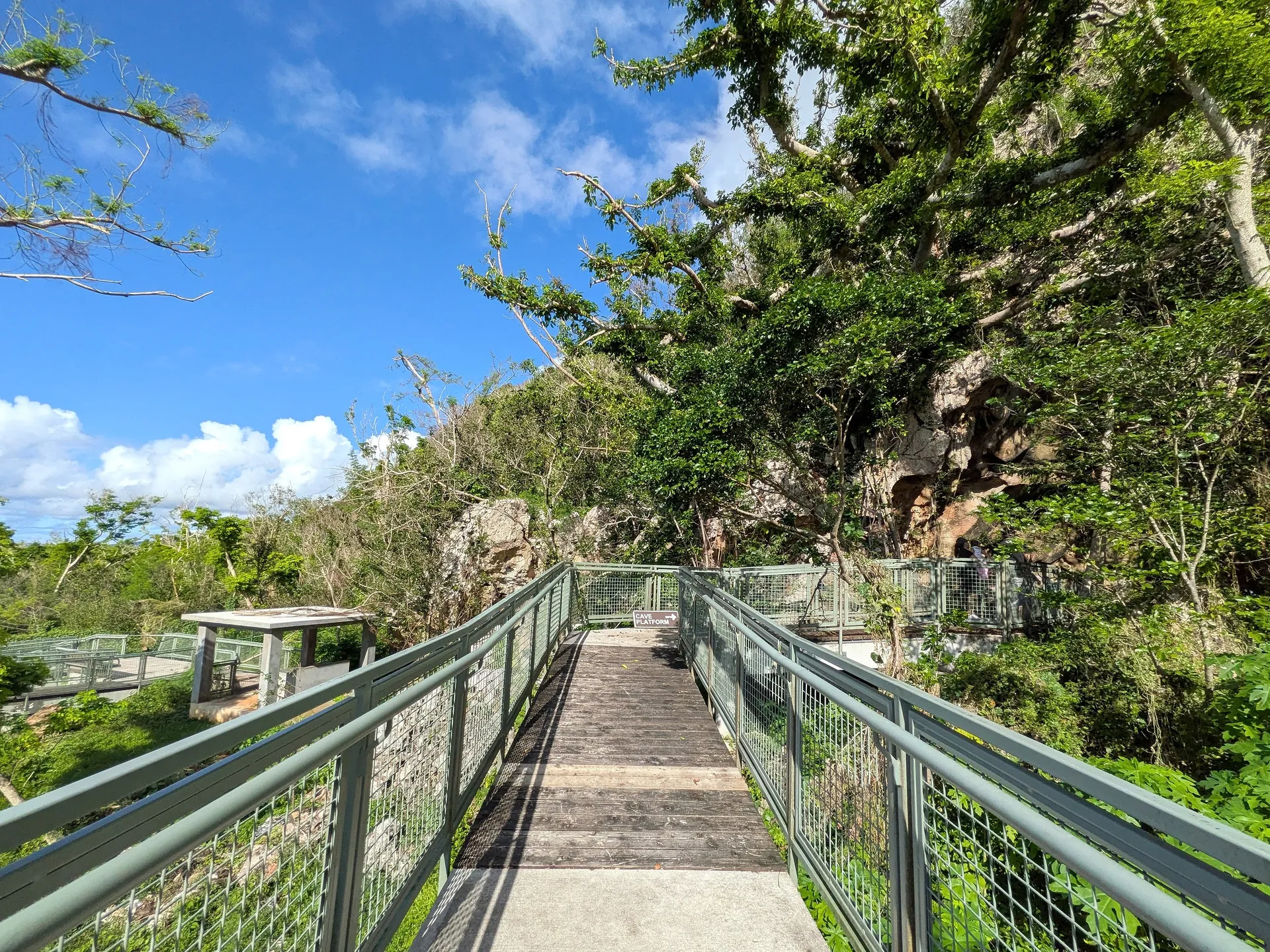
From there a paved path and a steel-railed boardwalk climb to a viewing platform at the cave mouth. That’s as far as you go — the interior isn’t open to walk into, which means the engravings themselves stay out of sight. It’s a genuine limitation of the visit, and better to know going in than to arrive expecting a cave tour.
Current condition
The site has taken storm damage that hasn’t been repaired. A fallen tree is lying across part of the boardwalk railing and bench near the upper level, one wayfinding sign is off its post and propped on the ground, and there’s uncleared debris along the walkway. None of it stops you getting to the platform, but the site is clearly waiting on maintenance it hasn’t had yet.
Getting there
Kalabera Cave is roughly 30–40 minutes from Garapan, and it’s the far end of the Windward Road run along the northeast coast. The new road is what makes this practical — reaching the site used to be a considerably rougher trip.
The established pattern is to do the three together: Unai Fanhang first, then Unai Nanasu, then up to Kalabera Cave. Fanhang and Nanasu are coastal and exposed; Kalabera is inland and shaded, which makes it a sensible last stop once the sun is high.
Further north into Marpi, Banzai Cliff and Bird Island Lookout round out the northern end of the island if you’ve got a longer day.
Visitor Etiquette
- This is a burial site and it matters to CHamoru families today. Treat it the way you'd treat a cemetery — quiet voices, no climbing, no horseplay.
- Stay on the boardwalk and behind the platform railing. The cave interior is not open to walk into.
- Do not touch, chalk, trace or light the rock engravings — surface oils and abrasion destroy them permanently.
- Take nothing. Removing anything from the cave — rock, bone, artefact, ordnance — is both illegal and a desecration.
- If you find an offering left at the site, leave it alone.